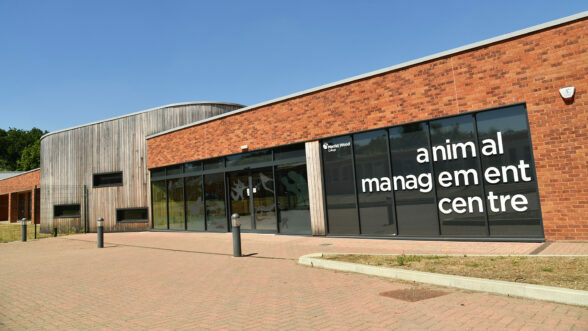
The T Level in Animal Management and Science is a two-year programme designed for learners looking to develop the advanced technical knowledge, practical skills, and industry experience required for a career in the animal management sector or progression to higher education. Equivalent to three A Levels, the qualification combines classroom-based learning with substantial industry placement, giving learners a strong foundation for employment, apprenticeships, or university study.
Developed in collaboration with employers, the programme reflects the knowledge, skills and behaviours required within the animal management industry. Learners will study a range of scientific and technical topics that underpin successful animal care and management, including health and safety, animal anatomy and physiology, biological cells and tissues, nutrition, health and disease, and the principles of animal welfare. Through a combination of theoretical study, practical learning, and industry placement, learners will develop the scientific understanding and professional skills needed for future study and employment in the animal sector.
Based at Merrist Wood College, learners have access to industry-leading animal management facilities, including collections of domestic, companion and exotic animals, specialist animal accommodation, canine care facilities, and dedicated practical teaching resources and science laboratories. Students gain extensive hands-on experience working with a variety of species while developing the technical and professional skills expected within the sector.
Merrist Wood has strong industry links, and highly qualified, experienced staff deliver teaching and provide learners with technical expertise and current industry knowledge. Through a combination of academic study, practical learning and industry experience, learners develop the skills needed to succeed in a rapidly evolving animal management sector.
What you'll learn
Throughout the two-year programme, learners will develop the technical knowledge, practical skills and professional behaviours required for a successful career within the animal management sector. Through a combination of classroom-based learning, practical activities and industry experience, learners will gain an understanding of animal health, welfare, behaviour and management, alongside the wider skills required for employment in the industry.
Learners will study a broad range of topics relevant to both animal management and the workplace, including sustainability, ethical principles, communication, business and health and safety. They will also deepen their understanding of animal anatomy and physiology, behaviour, welfare, and husbandry, while gaining practical experience with a range of species at Merrist Wood’s Animal Management Centre.
Occupational Specialism Themes
- Animal biology
- Anatomy and physiology
- Genetics and reproduction
- Evolution and classification
- Laboratory skills
- Biochemistry and microbiology
- Conservation biology
- Animal health and welfare
- Research methods and data analysis
A key feature of the programme is completing a minimum 45-day (315 hours) industry placement. This provides valuable opportunities to apply learning in real working environments, further develop practical skills, and build the confidence, professionalism, and industry knowledge employers value.
How you'll learn and be assessed
Assessment is carried out through a combination of external examinations and practical assessment methods. Learners will complete three externally assessed examinations that test their knowledge and understanding of the core content, alongside an employer-set project that enables them to apply their learning to industry-relevant scenarios and challenges.
Learners will also undertake a synoptic assessment as part of their occupational specialism, requiring them to demonstrate the practical skills, technical knowledge and professional behaviours developed throughout the programme. This assessment reflects real-world industry practice and requires learners to integrate their learning in a practical context.
The programme combines classroom-based learning with practical animal management activities. Practical sessions take place within the Animal Management Centre and the wider Merrist Wood estate, providing opportunities to develop advanced technical skills in animal handling, husbandry, welfare monitoring, behaviour assessment, and animal management in a professional working environment.
A key requirement of the qualification is completing a minimum 45-day (315 hours) industry placement. This enables learners to apply their skills and knowledge in the workplace, develop professional behaviours and gain valuable experience within the animal management sector.
Students will also continue to develop their English, maths and digital skills as part of their study programme where appropriate.
Learners must successfully complete all core assessments, occupational specialism assessments and industry placement requirements to achieve the qualification.
Progression
Successful completion of the T Level in Animal Management & Behaviour can lead to progression onto higher education, higher apprenticeships or employment within a wide range of animal-related industries. Learners develop the technical knowledge, practical skills, and industry experience employers value across the animal care, welfare, conservation, and management sectors.
The qualification provides a strong foundation for progression to university courses such as:
- Animal Science
- Animal Behaviour and Welfare
- Zoology
- Veterinary Nursing/Bioscience/Physiotherapy
- Wildlife Conservation
- Ecology and Conservation Management
- Applied Animal Science
The programme also develops transferable skills, including communication, problem-solving, teamwork, professionalism, and workplace practice, supporting progression into further study, apprenticeships, and employment, subject to individual achievement and any relevant entry requirements.
Possible Career Pathways:
- Veterinary Support Services
- Animal Nutrition
- Animal Welfare and Rescue
- Zoo and Wildlife Management
- Conservation and Ecology
- Animal Health and Disease Monitoring
- Laboratory Animal Care
Whether progressing into higher education or directly into employment, the T Level provides a strong platform for a rewarding career working with animals in settings such as welfare organisations, zoos, wildlife collections, conservation projects, rehabilitation centres, kennels, catteries, pet retail businesses and other animal care and management environments.
Entry requirements
Applicants must have a minimum of 4 GCSEs at Grade 5 and above, including English Language, Maths and Science, plus one other or a Level 2 qualification at Merit or above.
Additional information
Attendance at a Meet the Teacher is compulsory for all applicants and forms part of the enrolment process.
As this programme is delivered within a professional animal care environment, learners are expected to adhere to the dress code and standards of Merrist Wood College. A programme uniform is required for practical sessions, consisting of either navy cargo trousers or overalls and logo navy polo shirt.
For health and safety reasons, learners must remove jewellery, tie long hair back securely, and wear weather-appropriate clothing when undertaking outdoor activities.
Learners are also required to provide and wear the following personal protective equipment (PPE):
- Suitable safety/work boots/wellies
All practical activities are subject to health and safety requirements, and learners must wear the appropriate uniform and PPE to participate.
Financial support may be available through the College bursary scheme. Learners who meet the eligibility criteria may be able to receive assistance towards the cost of the required uniform and PPE equipment.